Who Goddess Durga is
Durga is the supreme goddess of the Shakta tradition — the embodiment of cosmic feminine power, the slayer of the buffalo demon Mahishasura, and the protector of the cosmos when male divinity proves insufficient. Her name comes from the Sanskrit durga, meaning “fortress” or “the one difficult to reach,” and her presence in Hindu devotion combines fierce martial energy with maternal grace.
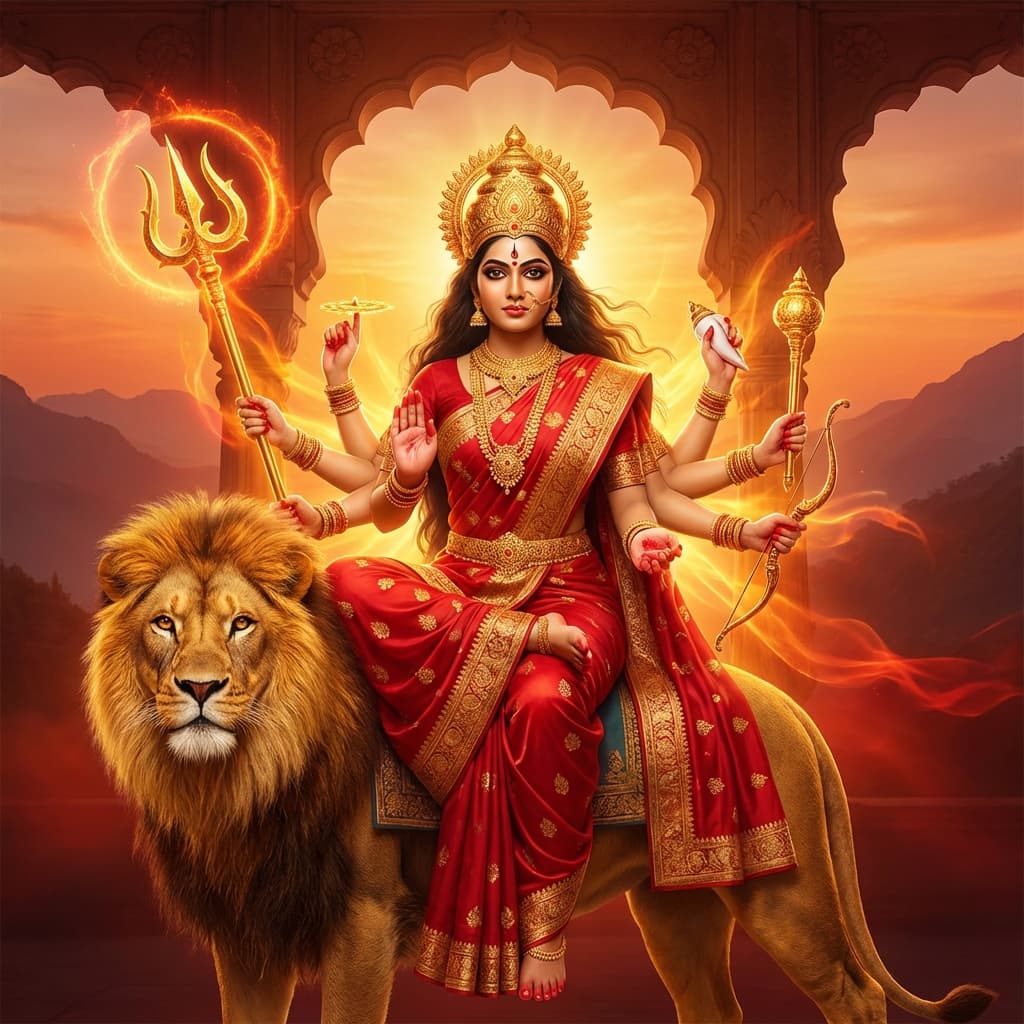
The earliest sustained portrait of Durga appears in the Devi Mahatmya, a sixth-century Sanskrit text embedded in the Markandeya Purana. There, the gods, defeated by Mahishasura, pool their tejas — their luminous power — into a single radiant form, and that form is Durga. She rides a lion or tiger, carries a different weapon in each of her many arms (trident, sword, discus, bow, mace, conch, lotus), and appears, fights, and triumphs. The tale gives the festival of Navaratri its narrative spine.
Iconography and symbolism
Durga is portrayed astride a lion or tiger — the mount signifying mastery over raw, predatory force. In the classic Mahishasura-mardini image she has eight or ten arms, each bearing a weapon contributed by one of the gods: the trident (trishula) of Shiva, the discus (chakra) of Vishnu, the conch of Varuna, the thunderbolt of Indra, the bow of Vayu, the sword, the mace, and the lotus among them. The pooling of every god’s weapon into her hands makes a theological point — that the goddess is not one power among many but the totality of divine power gathered in a single form. Her serene face above a body in the act of slaying the demon holds together the two poles of her nature: unshakeable calm and decisive strength.
The nine forms — Navadurga
Across the nine nights of Navaratri, tradition worships Durga in nine forms, the Navadurga, one for each night: Shailaputri (daughter of the mountain), Brahmacharini (the ascetic), Chandraghanta (bearer of the crescent-bell), Kushmanda (source of cosmic warmth), Skandamata (mother of Skanda), Katyayani (the warrior born of sage Katyayana’s austerity), Kalaratri (the dark night that destroys fear), Mahagauri (the luminously fair), and Siddhidatri (giver of spiritual attainment). The sequence traces a movement from origin through discipline and battle to fulfilment, and many households structure their nine days of fasting and recitation around it.
Festivals and worship days
Durga is worshipped most intensely during Navaratri — nine nights of fasting, recitation, and ritual that fall in autumn (Sharad Navaratri, around September–October) and again in spring (Vasant Navaratri, around March–April). The autumn festival culminates in Vijayadashami or Dussehra, the tenth day on which Durga’s victory over Mahishasura is celebrated. In Bengal and parts of eastern India, the same period is observed as Durga Puja, with elaborate clay images of the goddess installed in community pandals.
Friday and Tuesday are the conventional weekly days for Durga worship, though Navaratri practice transcends weekday cycles.
How devotees worship Durga
Navaratri worship often opens with ghatasthapana (also called kalash sthapana) — the installation of a consecrated water-pot and the sowing of barley seeds, kept for the nine days as a living emblem of the goddess. Many keep a vrat (fast) through the nine nights, taking fruit, milk, or a single sattvic meal, and maintain an akhand jyoti, a lamp kept continuously alight. Red is the goddess’s colour: devotees offer red hibiscus and other red flowers, a red chunri (cloth), and sindoor. The Durga Saptashati (the Devi Mahatmya, 700 verses) is recited in full by the devout, while shorter forms serve daily practice. On Ashtami or Navami many perform Kanya Pujan, honouring young girls as living embodiments of the goddess with food and small gifts.
What devotees seek
Durga is invoked for protection from harm, courage in adversity, victory over inner and outer enemies, and the strength to face circumstances larger than oneself. The Devi Mahatmya is considered a complete devotional cycle in itself; the Durga Chalisa and Durga Aarti are shorter, householder-friendly forms.
The Durga texts on this page
The texts collected here gather the best-known of these compositions for daily and Navaratri practice. The Durga Chalisa offers forty verses of praise in an accessible, roughly seven-minute recitation, while the Durga Aarti (“Ambe Gauri”) is the lamp-offering song sung at the close of worship. Each is presented with full text, line-by-line meaning, historical background, and guidance on how to chant.