
Goddess Lakshmi
The goddess of fortune, prosperity, and beauty — consort of Vishnu and presiding deity of Diwali.
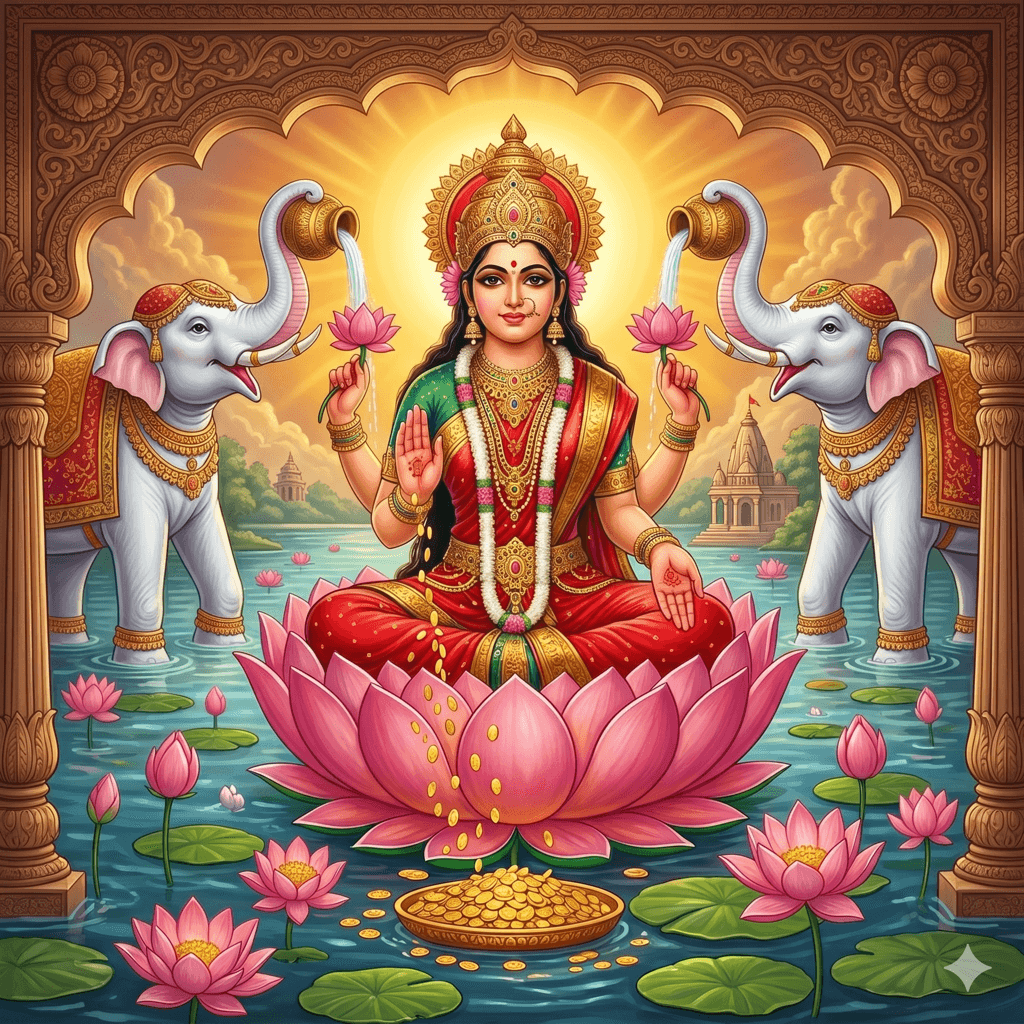
Who Goddess Lakshmi is
Lakshmi is the goddess of shri — auspiciousness in its fullest sense — and the consort of Vishnu. Shri is conventionally translated “wealth” or “fortune,” but in the texts the word reaches further: it is the radiance of a well-kept household, the abundance of a harvested field, the dignity of a person at ease, the beauty that arises when life is lived in alignment with dharma. Lakshmi is what makes a home a home, a kingdom a kingdom, a life a life.
She is depicted seated or standing on a fully bloomed lotus, two of her four arms holding lotuses, the other two raised in blessing or pouring forth gold coins. She is flanked by elephants who bathe her with water from their trunks — the Gajalakshmi iconography found from the second century BCE onwards. She emerged, in the most famous origin story, from the Samudra Manthan — the cosmic churning of the ocean of milk — choosing Vishnu from among all the gods and demons present.
The eight Lakshmis
Bhakti tradition speaks of Ashta-Lakshmi — eight forms of the goddess, each presiding over a different aspect of abundance: Adi Lakshmi (the primordial), Dhana Lakshmi (wealth), Dhanya Lakshmi (food and grain), Gaja Lakshmi (animals and prosperity), Santana Lakshmi (progeny), Veera Lakshmi (courage), Vidya Lakshmi (knowledge), and Vijaya Lakshmi (victory). The Lakshmi Chalisa and several stotras invoke these forms together.
Iconography and symbolism
The lotus on which Lakshmi stands, and which she holds, is the key to her meaning: rooted in mud yet blossoming immaculate above the water, it is prosperity that remains untainted by the world it grows from — abundance held without grasping. The gold coins streaming from her hand signify not hoarded wealth but wealth in flow, given as freely as it is received. The elephants bathing her stand for royal majesty and the fertilising rains, while her red garment and the company of the owl (in some traditions) round out an iconography that always balances fortune with grace. Lakshmi is rarely worshipped in isolation from Vishnu: as Lakshmi-Narayana the pair embody the truth that prosperity is auspicious only when wedded to dharma.
Festivals and worship days
Diwali — the festival of lights, falling on the new moon of Kartika (October–November) — is Lakshmi’s principal festival. Homes are cleaned, doors are opened, lamps are lit at every threshold, and Lakshmi is invited in for the Lakshmi Puja on the evening of the new moon. The festival also marks the start of the new business year for many trading communities.
Friday is the conventional weekly day for Lakshmi worship; Varalakshmi Vratam is observed on the Friday before the full moon of Shravana (July–August), particularly in south India.
How devotees worship Lakshmi
Lakshmi worship begins with cleanliness: the tradition holds that she enters only a home that is clean, lit, and orderly, which is why Diwali is preceded by a thorough cleaning and the lighting of lamps at every threshold. On Diwali evening devotees perform Lakshmi Puja, often alongside Ganesh, offering lotus flowers, red or pink blooms, sweets and kheer, and sometimes cowrie shells and coins that are kept in the home afterward as tokens of her presence. The Sri Suktam is recited for her invocation, and the doors are left open to welcome her in. Weekly worship falls on Friday, frequently with a fast broken after the evening lamp.
What devotees seek
Lakshmi is invoked for prosperity, for the well-being of the household, for the success of new ventures, for relief from debt, and for the deeper auspiciousness — the shri — that makes the outer wealth meaningful.
The Lakshmi texts on this page
The texts collected here include the Lakshmi Chalisa, the Om Jai Lakshmi Mata aarti, the Mahalakshmi Ashtakam (attributed to Indra in the Padma Purana), the Kanakadhara Stotram of Adi Shankaracharya — composed, in tradition, to summon a rain of golden fruit for a poor devotee — and the Vedic Sri Suktam from the Rigveda Khila. Each is presented with full text, line-by-line meaning, historical context, and guidance on how to chant.