Lord Hanuman
The devotee of Lord Rama, symbol of strength and devotion.
Who Lord Hanuman is
Hanuman is the vanara (forest-dwelling, monkey-formed) devotee of Rama, the central hero of the Sundara Kanda of the Ramayana, and one of the most beloved deities in popular Hindu devotion. He is the archetype of bhakti — selfless, fearless devotion that asks nothing for itself — and the patron of strength, courage, celibacy, learning, and the breath itself. He is also called Bajrangbali (the one with limbs of thunderbolt), Maruti (son of Maruta, the wind-god Vayu), Pavanaputra, Anjaneya (son of Anjana), and dozens of other names that catalogue his lineage and deeds.
The Ramayana presents Hanuman as the messenger who crosses the ocean to find Sita in Lanka, the warrior who burns the demon-city, the healer who carries the Sanjivani mountain to revive Lakshmana, and finally the immortal who remains on earth wherever Rama’s name is sung. The Sundara Kanda — the fifth book of the epic — is read in many households on Tuesdays and Saturdays for protection and for the resolution of stuck circumstances.
Iconography and symbolism
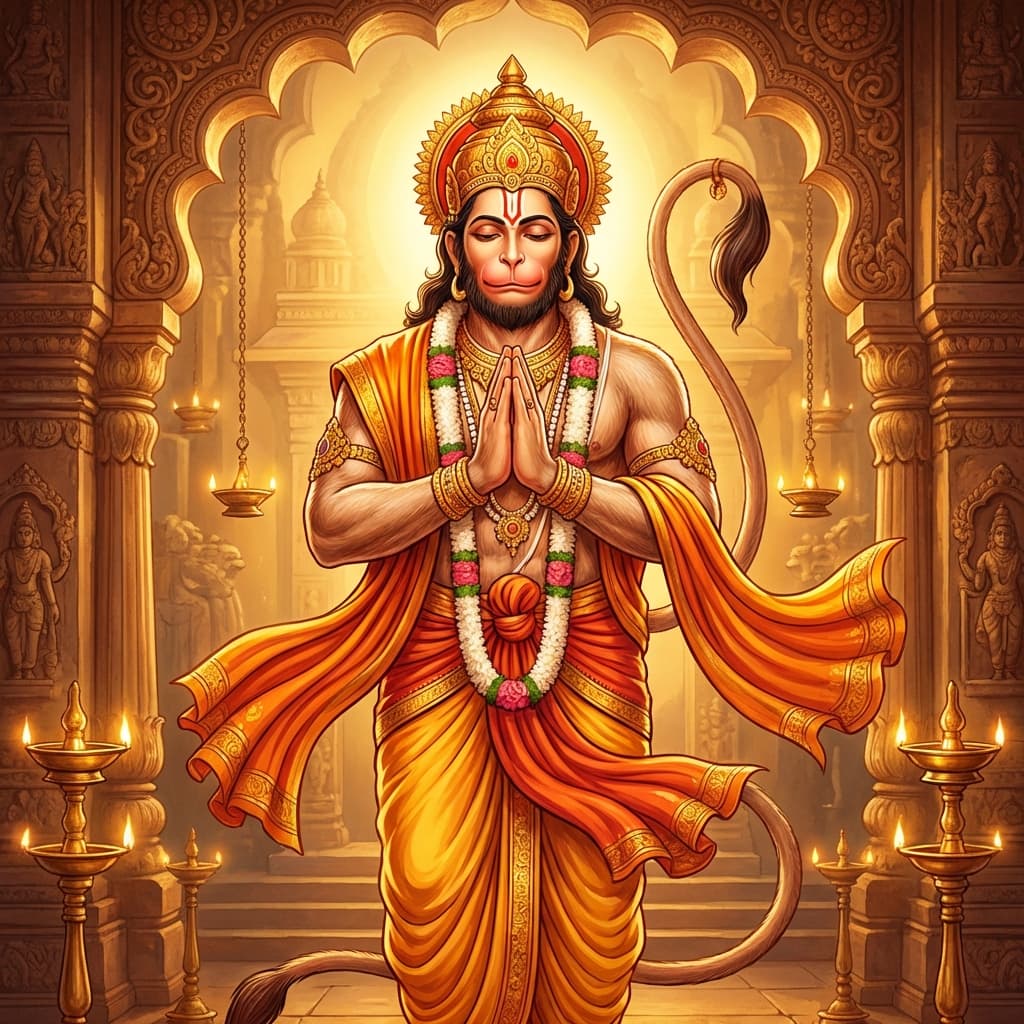
Hanuman is most often depicted as a powerful vanara with a reddish-orange body, carrying a gada (mace) that marks his strength and authority. Two poses recur in temple imagery. In the first he flies or leaps, sometimes bearing an entire mountain in one hand — the episode in which he carries the Sanjivani-bearing peak to revive the wounded Lakshmana, an emblem of selfless service. In the second he kneels with palms folded before Rama, the picture of humility.
The most striking image shows Hanuman tearing open his own chest to reveal Rama and Sita enshrined within his heart — a visual argument that the divine dwells wherever devotion is total. His images are traditionally smeared with sindoor (vermilion); a widely-told folk narrative holds that, on seeing Sita apply sindoor for Rama’s long life, Hanuman covered his whole body in it out of love. A fierce tantric form, Panchmukha Hanuman (five-faced, combining the faces of Hanuman, Narasimha, Garuda, Varaha, and Hayagriva), is invoked for protection in specific traditions.
Festivals and worship days
Hanuman Jayanti — Hanuman’s birthday — is the principal festival, celebrated on the full moon of Chaitra (March–April) in north India, and on different dates in Karnataka, Tamil Nadu, and Telangana, reflecting regional traditions about when Hanuman was born.
Tuesday and Saturday are the conventional weekly days for Hanuman worship across India. Devotees commonly recite the Hanuman Chalisa eleven, twenty-one, or one hundred and eight times on these days, fast, visit a Hanuman temple, or offer sindoor — the orange-red pigment with which his images are smeared as a mark of his unbroken bond with Rama.
How devotees worship Hanuman
The customary weekly observance falls on Tuesday or Saturday. Devotees apply sindoor mixed with oil — jasmine (chameli) or mustard oil are common — to the image, light a lamp of mustard or sesame oil, and offer besan or boondi laddus, bananas, jaggery, betel leaves, and a garland of flowers. Recitation follows: the Hanuman Chalisa (typically 1, 7, 11, 21, or 108 times), the Bajrang Baan, or a reading of the Sundara Kanda.
Many keep a Tuesday fast (vrat), eating a single meal, often avoiding salt or taking only fruit, according to family custom. Because Hanuman embodies brahmacharya — disciplined, celibate strength — wrestlers and athletes in traditional akharas have long revered him as their patron. He is also invoked for relief from the malefic effects of Saturn (Shani), and for protection against fear, ill-will, and disturbed sleep.
What devotees seek
Hanuman is invoked for strength in adversity, for protection from fear and from harm both visible and unseen, for the breaking of stubborn obstacles, for victory over enemies, and for the dissolution of accumulated karmic burdens. He is also the patron of students, athletes, wrestlers, and those undertaking long or difficult journeys.
The Hanuman texts on this page
The Hanuman Chalisa, attributed to the sixteenth-century poet-saint Tulsidas, is by some measures the single most-recited devotional text in the Hindi-speaking world — forty verses framed by two dohas, collected here with verses, line-by-line meaning, and historical context. The Bajrang Baan (“arrow of Bajrangbali”) is a more intense, protective invocation traditionally recited in times of acute difficulty; several recensions circulate. The Sankat Mochan Hanuman Ashtak — eight verses whose title means “reliever of troubles,” traditionally attributed to Tulsidas — recounts Hanuman’s rescues from the epics as grounds for present help. Each is presented here for daily and Tuesday/Saturday practice, with full text, meaning, and guidance on how to chant.