
Lord Krishna
The eighth avatar of Vishnu — the divine cowherd, charioteer of Arjuna, and speaker of the Bhagavad Gita.
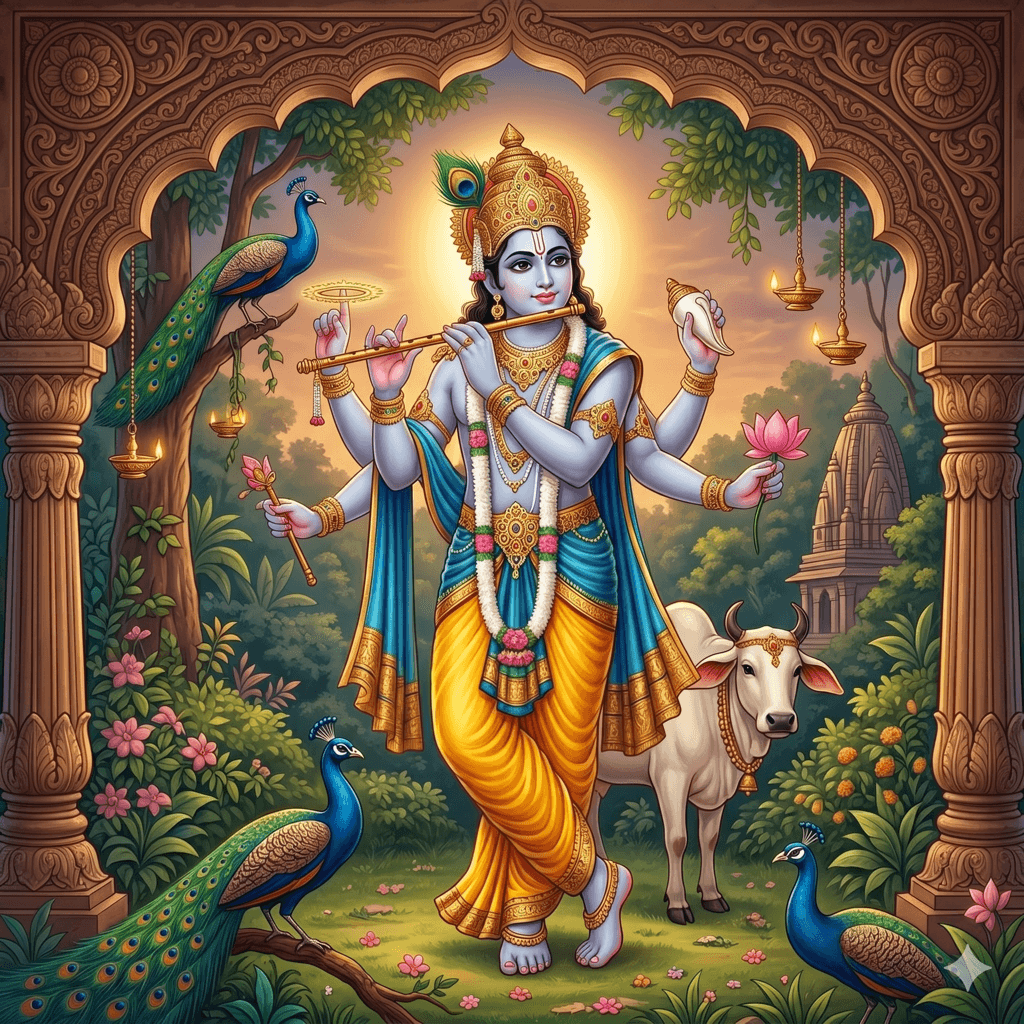
Who Lord Krishna is
Krishna is the eighth avatar of Vishnu in the classical Dashavatara reckoning, and in the theology of many bhakti traditions he is svayam bhagavan — God himself, of whom the other avatars are partial descents. His life, told in the Bhagavata Purana, Mahabharata, and Harivamsha, is among the most narratively rich in any religious tradition: the cowherd child of Yashoda and Nanda in Gokul; the flute-playing lover of the gopis on the banks of the Yamuna; the prince and statesman of Dwarka; and the charioteer-philosopher who delivers the Bhagavad Gita to Arjuna on the field of Kurukshetra.
These multiple Krishnas — child, lover, king, teacher — are not held in tension by the tradition; they are read as facets of the same divine play, lila. Different sampradayas emphasise different facets: the Pushtimarg of Vallabhacharya centres the cowherd-child, the Gaudiya tradition of Chaitanya centres Krishna with Radha in Vrindavan, and the Gita-centric traditions read Krishna primarily as cosmic teacher.
Iconography and symbolism
Krishna is most often shown in the tribhanga posture — the body gently curved at neck, waist, and knee — playing the bansuri (bamboo flute), whose sound is the call of the divine that draws the soul out of itself. A peacock feather rises from his crown, and he wears pitambara, yellow silk, against a complexion painted dark blue or black — the colour of the infinite, the rain-cloud, the fathomless sky. He is surrounded by the cows and cowherds of Vrindavan and, in devotional imagery, by Radha, whose love for him the tradition holds as the highest emblem of the soul’s longing for God. The lifting of Mount Govardhan on his little finger, a recurring motif, marks him as the shelter of his devotees.
Festivals and worship days
Janmashtami — Krishna’s birthday — falls on the eighth day of the dark fortnight of Bhadrapada (August–September) and is celebrated with night-long fasts, recitations of the Bhagavata Purana’s tenth book, and at midnight the symbolic birth of Krishna in the temple. In Mathura and Vrindavan, the festival fills the towns for days. Holi — the festival of colours — also has deep Krishna associations through the lila of Krishna and Radha throwing colour at each other in Barsana.
Wednesday is the conventional weekly day for Krishna worship; Ekadashi is observed by many Krishna devotees as a fasting day.
How devotees worship Krishna
Krishna worship is distinctively joyful, carried as much by song as by ritual. Tulsi (holy basil) is essential — the tradition holds that Krishna does not accept an offering without a tulsi leaf — and the customary food offering is makhan-mishri (butter and rock-sugar), recalling his childhood love of stolen butter. Devotees sing bhajans and kirtans, the Hare Krishna mahamantra foremost among them, and rock the infant Krishna in a decorated cradle (jhula) at Janmashtami. Many keep the Ekadashi fast twice a lunar month. Weekly worship falls on Wednesday, with a lamp, flowers, and a reading of a chalisa, aarti, or stotra.
What devotees seek
Krishna is invoked for love in its many forms — the love of parent and child, of beloved and lover, of friend and friend, of devotee and Lord — and for the dissolution of pride that makes any of these loves possible. The Bhagavad Gita is read for guidance in moments of moral paralysis; the Bhagavata’s tenth book is read for the cultivation of devotion; the simpler chalisas, aartis, and stotras are recited daily.
The Krishna texts on this page
The texts collected here include the Krishna Chalisa, the Aarti Kunj Bihari Ki, the Madhurashtakam of Vallabhacharya — eight verses on the all-pervading sweetness (madhurya) of Krishna — and the Achyutam Keshavam, a beloved refrain-hymn of his names. Each is presented with full text, line-by-line meaning, historical context, and guidance on how to chant. Other classic Krishna compositions, such as the Govind Damodar Stotram of Bilvamangala Thakur, are being prepared for addition.