Who Lord Vishnu is
Vishnu is one of the three principal deities of the Hindu trimurti — alongside Brahma the creator and Shiva the dissolver — and is venerated as the preserver and sustainer of the cosmos. Where Brahma’s role is brief and confined to the moment of cosmic emanation, and Shiva’s role unfolds at dissolution, Vishnu’s work is the long, patient, ongoing maintenance of dharma across cycles of cosmic time.
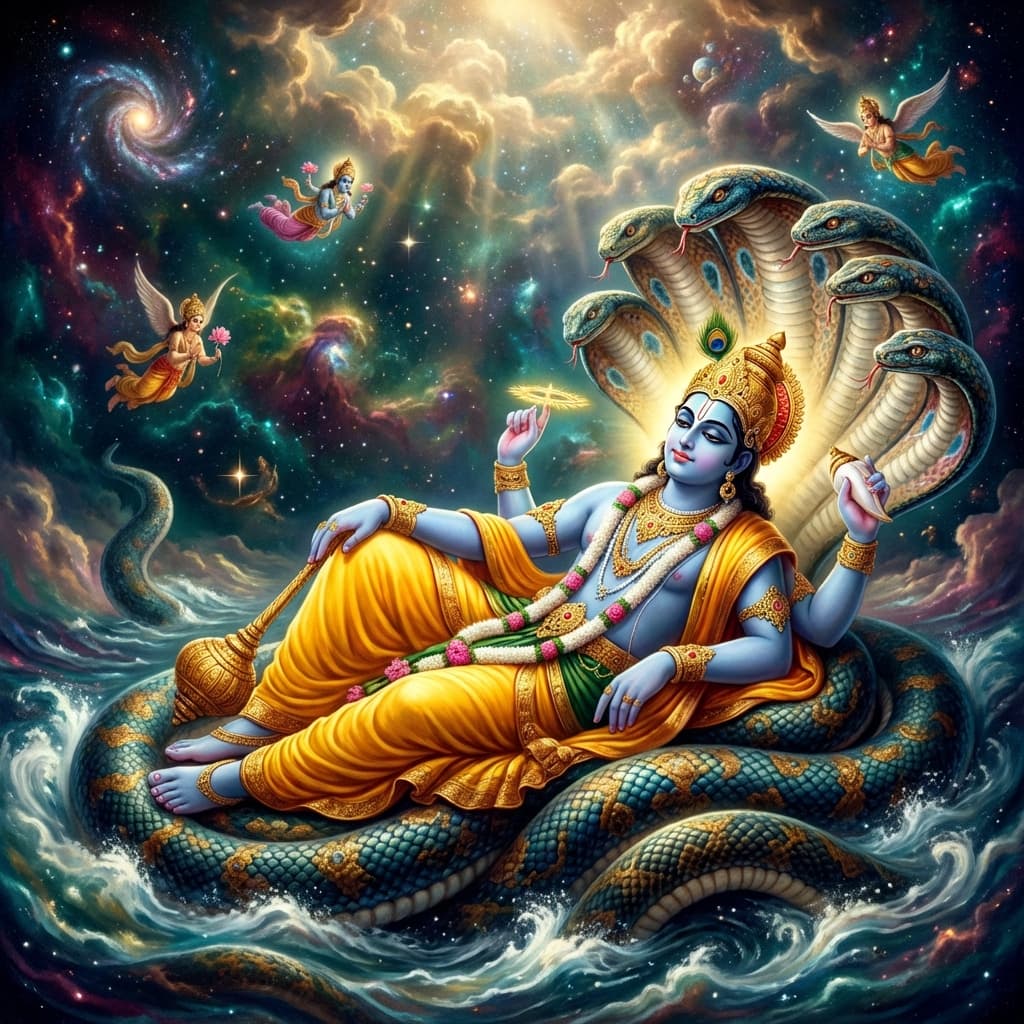
He is most often depicted with four arms, holding the shankha (conch), chakra (discus), gada (mace), and padma (lotus). He reclines on the serpent Sheshanaga upon the cosmic ocean, with Lakshmi at his feet, and from his navel rises the lotus that holds Brahma. His mount is Garuda, the great eagle.
Iconography and symbolism
Each object Vishnu bears carries meaning. The conch, Panchajanya, sounds the primordial vibration from which creation unfolds; the discus, Sudarshana, is the whirling wheel of time and mind that severs ignorance; the mace, Kaumodaki, is the authority of sustaining power; and the lotus is purity and the unfolding of the manifest world. On his chest he wears the Kaustubha gem and the curl of hair called Srivatsa, and he is clothed in pitambara, yellow silk. The serpent Shesha on whom he reclines represents the cosmic remainder that persists between cycles, while Garuda, his eagle mount, embodies the Vedas and fearless speed. Together the imagery presents a deity at rest yet wholly awake — stillness holding the universe in order.
Names and forms
Vishnu is approached through a wealth of names, each naming a facet of his work: Narayana (the one who rests on the cosmic waters), Hari (the remover of sorrow), Madhava, Govinda, Janardana, and Padmanabha (lotus-naveled) among them. The Vishnu Sahasranama — the thousand names of Vishnu, drawn from the Mahabharata — gathers these epithets into a single revered recitation. This multiplicity is not confusion but abundance: the tradition holds that the sustainer of all things cannot be exhausted by any one name.
The avatars
Vishnu’s most distinctive theological feature is the doctrine of avatara — descent. When dharma weakens and adharma rises, Vishnu takes form on earth to restore balance. The classical reckoning lists ten such descents, the Dashavatara: Matsya the fish, Kurma the tortoise, Varaha the boar, Narasimha the man-lion, Vamana the dwarf, Parashurama the warrior-sage, Rama, Krishna, Buddha, and the future Kalki. Each avatar carries its own scripture, festival, and devotional tradition; Rama and Krishna in particular have become the focal deities of vast sub-traditions in their own right.
This means that worship of Vishnu often passes through one of his avatars. The Bhagavad Gita is Krishna’s sermon to Arjuna; the Ramayana is Rama’s story; both are, in the Vaishnava reading, encounters with Vishnu in human form.
Festivals and worship days
Thursday is the conventional weekly day for Vishnu worship. Ekadashi — the eleventh day of each lunar fortnight — is observed as a fasting day across Vaishnava traditions. Major festivals include Vaikuntha Ekadashi (December–January), Rama Navami (Rama’s birthday, March–April), Janmashtami (Krishna’s birthday, August–September), and Narasimha Jayanti (April–May).
How devotees worship Vishnu
Weekly worship centres on Thursday, and the twice-monthly Ekadashi is kept as a fast — many take only fruit, milk, or non-grain food, breaking the fast the following morning. The tulsi (holy basil) leaf is essential to Vishnu worship; the tradition holds that he does not accept an offering without one, and a tulsi plant is tended in many Vaishnava homes. Devotees recite the Vishnu Sahasranama, sing the evening aarti, and offer yellow flowers, fruit, and sweets. The Satyanarayana Vrat Katha, a popular householder puja performed on full-moon days and family occasions, is among the most widespread forms of Vishnu devotion in India.
What devotees seek
Vishnu is invoked for protection, for the preservation of order in family and society, for stability in the face of upheaval, and for the long view — the trust that dharma will, eventually, prevail.
The Vishnu texts on this page
The most beloved Vishnu hymn collected here is the Om Jai Jagdish Hare aarti, sung in households across India at the close of the evening puja, while the Vishnu Chalisa offers a longer sequence of praise for daily recitation. Each is presented with full text, line-by-line meaning, historical context, and guidance on how to chant. Devotion to Vishnu’s avatars Rama and Krishna is gathered on their own pages.