Lord Surya
The Sun god — the visible deity, source of light, life, and time. Invoked daily through the Gayatri Mantra and Aditya Hridayam.
Who Lord Surya is
Surya is the visible deity — the sun in the sky, no symbol or proxy required — and one of the oldest objects of worship in the Vedic tradition. Where most Hindu deities are approached through image and story, Surya is approached directly: every dawn is his arrival, every dusk his departure, every day a complete cycle of his presence. The Vedic seers addressed hymns to him by name; the Gayatri Mantra, drawn from Rigveda 3.62.10, is in its plain reading a meditation on the sun’s light entering and quickening the meditator’s intellect.
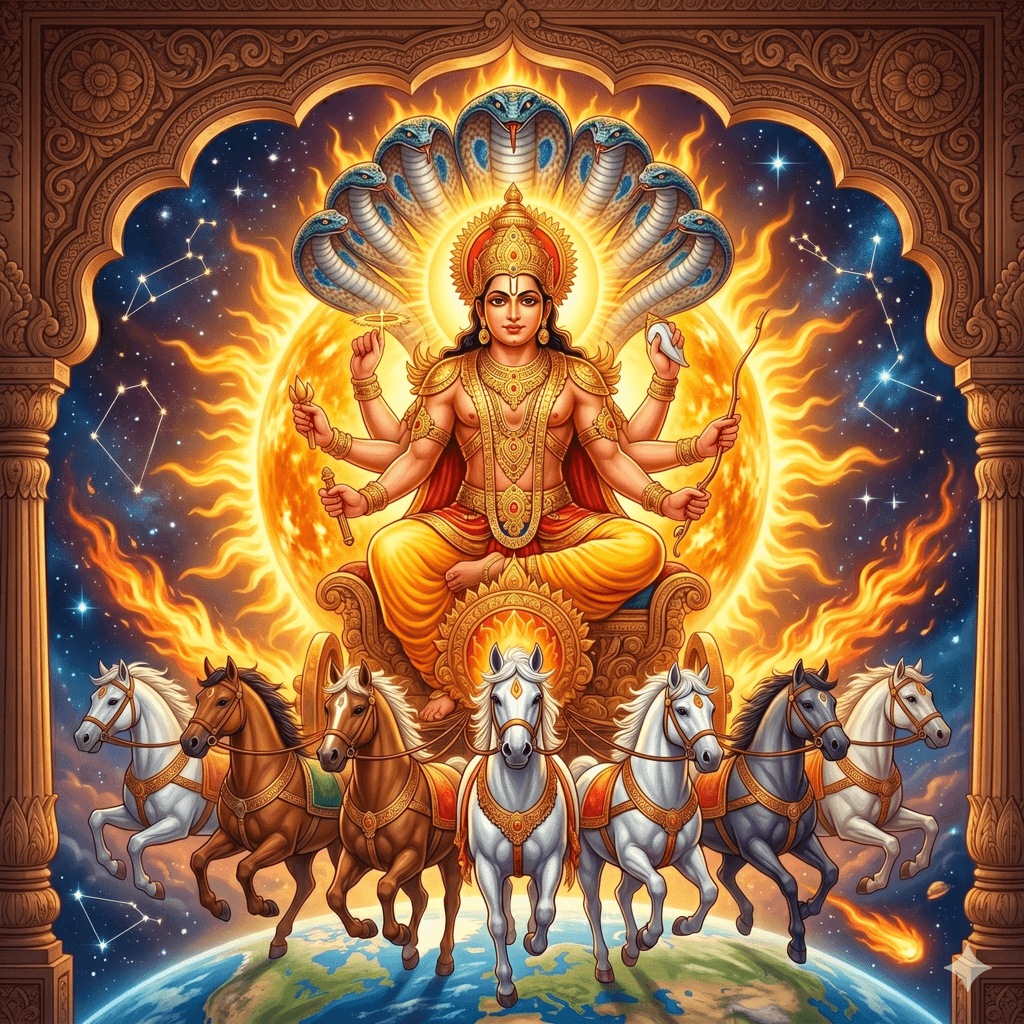
He is depicted riding a chariot drawn by seven horses (or one horse with seven heads) — the seven horses representing the seven colours of light, or the seven days of the week, or the seven metres of Vedic verse. His charioteer is Aruna, the dawn. His sons include Yama (lord of death), Yamuna (the river-goddess), the Ashvins (twin physicians), Karna (the hero of the Mahabharata), and Sugriva (the vanara king of the Ramayana).
The twelve Adityas
The Puranic tradition speaks of Dvadasha Adityas — twelve forms of the sun, one for each month of the year, each carrying a different aspect of solar energy: Mitra, Varuna, Aryaman, Daksha, Bhaga, Ansha, Dhata, Indra, Vivasvan, Pushan, Tvashta, and Vishnu. The Surya Chalisa invokes all twelve.
Iconography and symbolism
Surya’s imagery is a diagram of time and light. The seven horses of his chariot are read as the seven colours hidden in white light or the seven notes and metres of sacred sound; the single wheel of the chariot, in many descriptions, is the turning year. His charioteer Aruna — the reddish glow of dawn — sits before him because the light of daybreak precedes the sun itself. He holds lotuses in his hands, flowers that open only to his touch, and is often shown with a radiant prabhavali (halo), the one deity whose luminosity needs no metaphor. The great Sun Temple at Konark, built as a colossal stone chariot, is this iconography rendered in architecture.
Festivals and worship days
Sunday — the day named for him in nearly every world calendar — is the conventional weekly day for Surya worship. Ratha Saptami (the seventh day of the bright fortnight of Magha, January–February) marks his turn northward and is observed across south India with bathing rituals at sunrise. Chhath — the four-day festival observed in Bihar, eastern UP, Jharkhand, and parts of Nepal in the bright fortnight of Kartika (October–November) — is among the most physically demanding of Hindu festivals, with offerings made to the rising and setting sun while standing in river or tank water. Makar Sankranti (14–15 January) marks Surya’s transit into Capricorn and the beginning of the auspicious uttarayana — the six months of his northward journey.
How devotees worship Surya
Surya alone among the deities is worshipped by facing the object of worship itself. The central practice is Arghya — offering water to the rising sun at dawn, poured from a copper vessel while facing east, often through the fingers so the light refracts through the falling stream. Many accompany it with Surya Namaskar, the twelve-posture salutation, and with the Gayatri Mantra or the Aditya Hridayam. Sunday observance may include a single meal taken without salt or oil, and offerings of red flowers, wheat, and jaggery. The Chhath festival raises this daily discipline to its most rigorous form, with day-long fasts and standing water-offerings to both the setting and the rising sun.
What devotees seek
Surya is invoked for health, for vitality, for clarity of intellect (the medha asked for in the Gayatri Mantra), for relief from chronic illness, and for the dispelling of inner darkness — the literal and the metaphorical at once. The Aditya Hridayam — taught by the sage Agastya to Rama on the battlefield in the Yuddha Kanda of the Valmiki Ramayana — is the most powerful Surya stotra in the tradition and is recited at sunrise for strength in the face of insurmountable adversity.
The Surya texts on this page
The texts collected here include the Surya Chalisa, the Gayatri Mantra with word-by-word translation, the Aditya Hridayam with its Ramayana context, and the Surya Aarti (Om Jai Kashyap-Nandan) for daily Sunday worship. Each is presented with full text, line-by-line meaning, historical context, and guidance on how to chant.