Who Lord Shiva is
Shiva is one of the three principal deities of the Hindu trimurti — the dissolver in the Brahma–Vishnu–Shiva schema — and in the Shaiva tradition he is the supreme reality from which the cosmos arises and into which it returns. His names — Mahadeva (the great god), Mahesha, Bholenath (the simple-hearted lord), Neelkantha (the blue-throated), Nataraja (lord of the dance), Pashupati (lord of beasts) — each carry a story, a region, a way of approach.
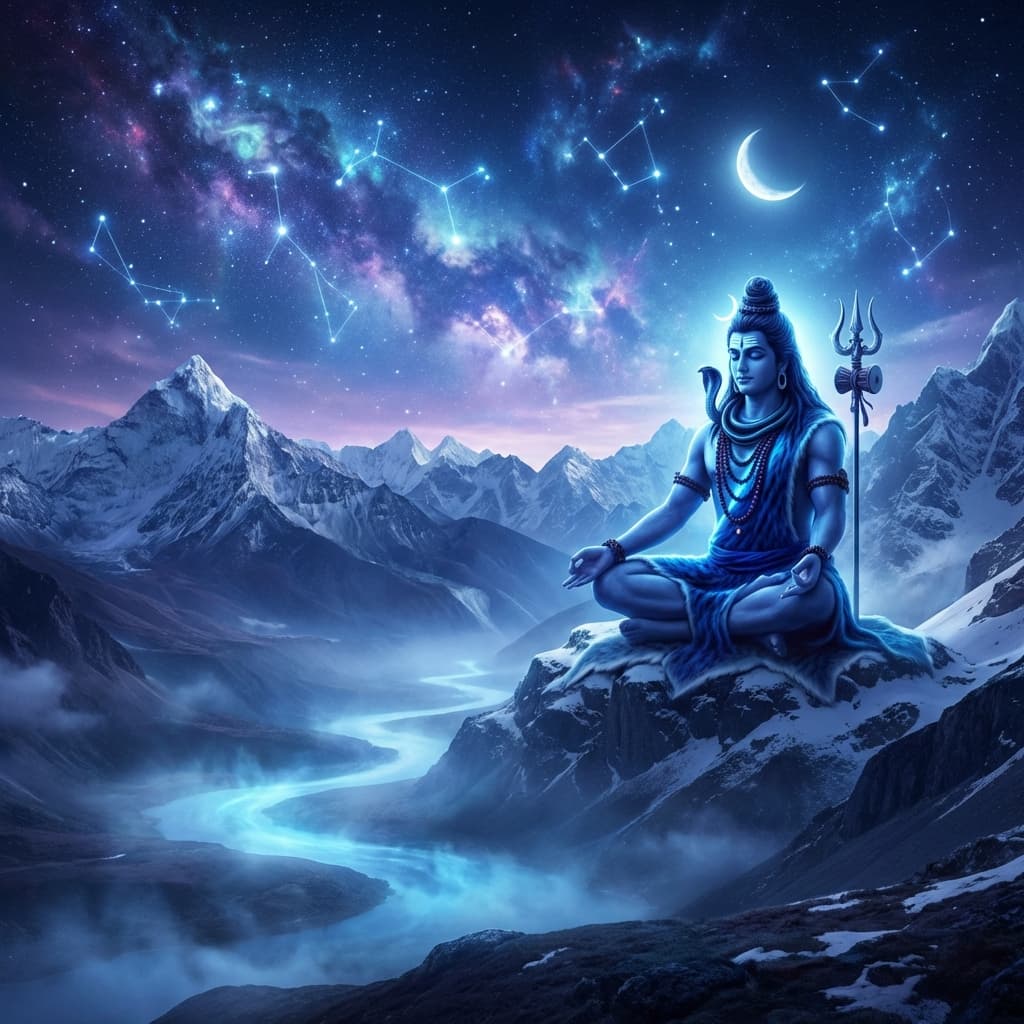
He is depicted as both ascetic and householder. As ascetic he sits in deep meditation on Mount Kailash, smeared with ash, his hair matted, the Ganga descending through his locks, the crescent moon at his brow, the serpent Vasuki around his neck. As householder he is the husband of Parvati and father of Ganesh and Kartikeya. Both portraits are held simultaneously in the tradition; neither is more authoritative than the other.
The lingam
The most distinctive object of Shiva worship is the lingam — a vertical, often cylindrical form placed in a yoni base. In Shaiva theology the lingam is anaadi anantam — without beginning or end — the formless reality made available to the senses for the purpose of devotion. It is not, as is sometimes claimed in colonial-era writing, a phallic symbol in the modern psychological sense; it is the mark (the literal meaning of linga) of the unmanifest absolute.
Iconography and symbolism
Shiva’s form is a compact theology. The third eye on his brow is the eye of inner wisdom, whose opening burns illusion to ash; the crescent moon at his hair marks his mastery of time and its cycles; the Ganga flowing from his locks is the descent of purifying grace, tamed so it does not shatter the earth. The trishula (trident) stands for the three gunas or the three times — past, present, future — held in one hand; the damaru (drum) sounds the primal vibration from which language and creation arise. The serpent coiled at his throat signals mastery over death and the coiled energy of kundalini, and the ash smeared on his body is the reminder that all forms return to it. As Nataraja, dancing within a ring of fire, he performs the Tandava — the dance in which the universe is created, sustained, and dissolved in a single rhythm. His mount, the bull Nandi, embodies steady, patient dharma.
Festivals and worship days
Maha Shivaratri — the great night of Shiva — falls on the fourteenth day of the dark fortnight of Phalguna (February–March) and is observed with night-long fasts, vigils, and recitations. Sawan (the lunar month of Shravana, July–August) is a month of intensified Shiva worship, particularly through the Kanwar Yatra — pilgrims walking with pots of Ganga water to pour on Shiva lingams.
Monday is the conventional weekly day for Shiva worship; the Mondays of Sawan are particularly important.
How devotees worship Shiva
Shiva is famously bhola — easily pleased — and his worship is correspondingly direct. Its heart is the abhishekam: the bathing of the lingam with water, milk, honey, curd, and Ganga water, accompanied by the chanting of the Rudra hymns (Rudrabhishek). Bilva (bael) leaves are his most treasured offering, along with datura, white flowers, and, in some regions, bhang. On Maha Shivaratri devotees keep a night-long vigil (jagran) with fasting and continuous recitation. The simple mantra Om Namah Shivaya — the panchakshara, or five syllables — is the core of daily Shiva practice, and the Mahamrityunjaya mantra is recited for healing and protection. Weekly worship falls on Monday.
What devotees seek
Shiva is invoked for the dissolution of what no longer serves — accumulated grief, stuck patterns, attachments that have outlived their usefulness — and for the deep stillness that makes that dissolution survivable. He is the patron of yogis, ascetics, householders in difficulty, and those who find their lives at a turning point.
The Shiva texts on this page
The texts collected here include the Shiva Chalisa, one of the most widely recited compositions for daily and Shivaratri practice, and the Maha Mrityunjaya Mantra — the “great death-conquering” verse from the Rigveda, chanted for healing, protection, and release from fear. Each is presented with full text, line-by-line meaning, historical context, and guidance on how to chant. Other classic Shiva texts, such as the Rudra Suktam and the Shiva Tandava Stotram, are being prepared for addition.