Sai Baba of Shirdi
The 19th–20th century saint of Shirdi, revered across faiths for his teachings of unity, faith, and patience.
Who Sai Baba of Shirdi is
Sai Baba of Shirdi (c. 1838 – 15 October 1918) was a saint who lived in the small village of Shirdi in present-day Ahmednagar district, Maharashtra, for roughly the last sixty years of his life. He is among the most widely venerated figures in modern Indian religious history, drawing devotees from Hindu, Muslim, Sikh, Parsi, and Christian backgrounds. Unlike most figures in this collection, he is a historical person of the recent past, and the documentary record of his life — eyewitness accounts, photographs, the Shri Sai Satcharitra of Govind Rao Raghunath Dabholkar (Hemadpant) — is unusually rich.
His origins are deliberately obscure. He arrived in Shirdi in his late teens or twenties; his birthplace, parentage, given name at birth, and religious upbringing were never disclosed by him and remain debated. He lived in a dilapidated mosque he renamed Dwarakamai, kept a sacred fire (dhuni) burning continuously, distributed its ash (udi) as a remedy and a blessing, and taught a path that did not require devotees to leave their existing tradition: he asked Hindus to remain Hindu and Muslims to remain Muslim, while he himself observed practices from both.
His teaching
His principal teachings, repeated again and again across the Satcharitra and the recollections of his devotees, are summarised in two formulas: Shraddha (faith) and Saburi (patience). To these are added the calls to give freely (dakshina), to harm no living being, to remember God in every act, and to recognise the same divinity in every face. He spoke in a mix of Marathi, Hindi, and Urdu, often in parables, sometimes in riddles, sometimes in straightforward instruction; the tone is consistently practical rather than philosophical.
He took mahasamadhi on 15 October 1918, the day of Vijayadashami, in the lap of his devotees, and was interred in what is now the Samadhi Mandir at Shirdi.
Iconography and worship at Shirdi
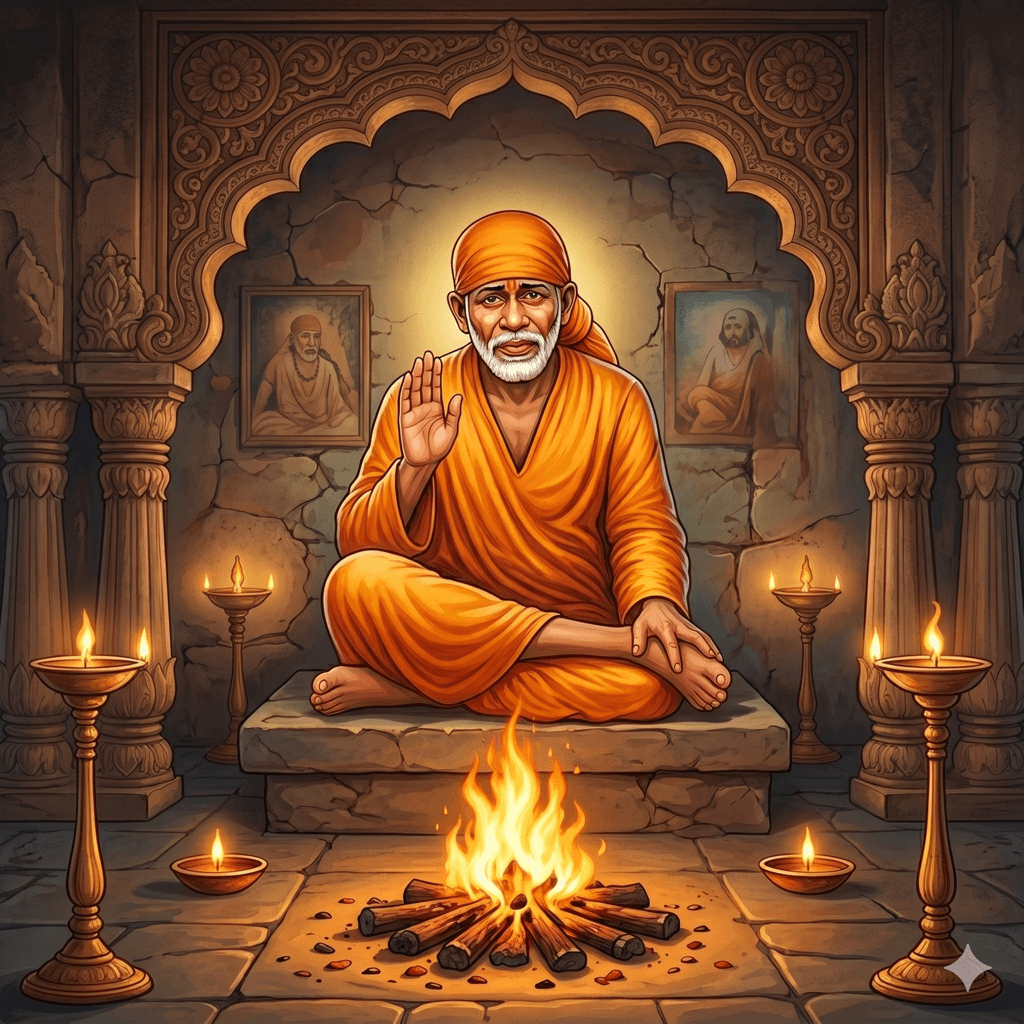
The familiar image of Sai Baba shows him seated on a stone with his right leg crossed over his left knee, one hand resting on it, wearing a simple kafni robe and a cloth wound about his head — a portrait taken from photographs made during his life rather than from iconographic convention. At Shirdi his presence is marked by the Dwarakamai mosque, the ever-burning dhuni whose ash (udi) is given to devotees, and the marble Samadhi Mandir built over his resting place. The temple observes a daily cycle of five aartis — Kakad (dawn), Madhyan (noon), Dhoop (dusk), and Shej (night) among them — sung to him as though to a living presence.
Festivals and worship days
Thursday is the conventional weekly day for Sai Baba worship — Thursdays at Shirdi see the largest gatherings, and devotees across India observe weekly Sai satsangs on this day. Three festivals are observed annually at Shirdi: Ram Navami (March–April), Guru Purnima (July–August), and Vijayadashami (September–October, the anniversary of his mahasamadhi).
How devotees worship Sai Baba
Devotion to Sai Baba is simple and householder-friendly, in keeping with his own emphasis on faith over ritual. On Thursdays devotees light a lamp before his image, offer flowers and sweets, apply udi to the forehead, and sing his aartis. Many undertake a Sai Satcharitra parayan — a reading of his life-story, often completed over seven days or across successive Thursdays — and keep his two watchwords, shraddha and saburi, as the substance of the practice. Charity in his name, especially the feeding of the hungry (annadaan), is considered among the truest forms of his worship.
What devotees seek
Sai Baba is invoked for protection, for the resolution of stuck circumstances, for the strength to bear what cannot yet be changed, and for the cultivation of the shraddha-saburi he himself taught. The udi from his dhuni remains a central physical token of his presence; his image, his mantra, and his name are kept in millions of homes.
The Sai Baba texts on this page
The texts collected here include the Sai Chalisa, the Marathi-origin aarti Aarti Sai Baba Saukhya-Datara Jeeva, and the principal Sai mantras for daily practice. Each is presented with full text, line-by-line meaning, historical context, and guidance on how to chant.