Lord Ram
The seventh avatar of Vishnu — the ideal king of Ayodhya and the central figure of the Ramayana.
Who Lord Ram is
Rama is the seventh avatar of Vishnu and the central hero of the Ramayana, the older of the two great Sanskrit epics. He is held up across Hindu tradition as maryada purushottama — the ideal man — embodying the disciplines of dharma: filial obedience, fraternal loyalty, marital fidelity, royal duty, and steadiness under suffering. Where Krishna’s appeal lies in his playful transcendence of convention, Rama’s lies in his unwavering adherence to it.
The Ramayana of Valmiki, composed in Sanskrit in the first millennium BCE, narrates Rama’s birth in Ayodhya, his marriage to Sita, his fourteen-year exile in the forest, the abduction of Sita by the demon-king Ravana of Lanka, the war to recover her with the help of Hanuman and the vanara army, and his eventual return to Ayodhya to be crowned king. Tulsidas’s sixteenth-century Awadhi retelling, the Ramcharitmanas, brought the story into the daily devotional life of north India and remains the most-read religious text in the Hindi belt.
Iconography and symbolism
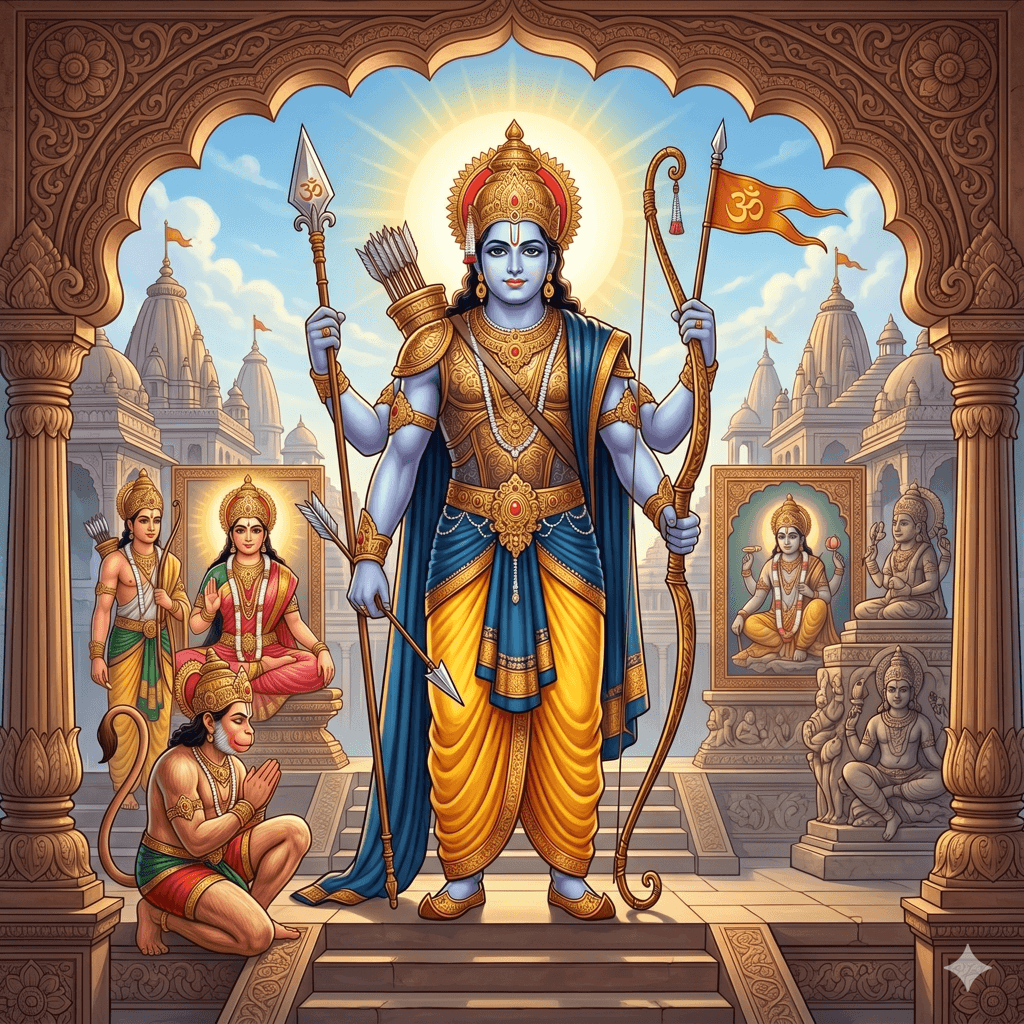
Rama is depicted as a serene, blue-complexioned prince bearing the Kodanda, the great bow, and a quiver of arrows — the weapon of a warrior who fights only in the cause of dharma, never for conquest. The most beloved image is the Ram Darbar (Rama’s court): Rama and Sita enthroned together, his devoted brother Lakshmana at his side, and Hanuman kneeling at his feet, the picture of perfect service. Together the group depicts an ideal order — righteous rule, faithful partnership, loyal kinship, and selfless devotion — each figure a facet of dharma held in balance. His blue colour, shared with Krishna and Vishnu, marks the infinite taking finite form.
The power of Rama-nama
Central to Rama devotion is the practice of Rama-nama — the repetition of the name “Rama” itself. The bhakti traditions hold this to be among the simplest and most powerful of all practices: it requires no ritual apparatus, no fixed time or place, and is available to anyone in any condition. Saints from Tulsidas to Kabir to Mahatma Gandhi placed the name at the centre of their practice, and the phrase Sitaram or Jai Shri Ram serves millions as both greeting and prayer.
Festivals and worship days
Rama Navami — Rama’s birthday — is celebrated on the ninth day of the bright fortnight of Chaitra (March–April), with recitations of the Ramayana, fasting, and processions in Ayodhya, Rameswaram, and across the country. Vijayadashami or Dussehra marks Rama’s victory over Ravana on the tenth day of the bright fortnight of Ashvin (September–October); in many cities, effigies of Ravana, Kumbhakarna, and Meghnad are burned at sunset. Diwali itself, in north Indian tradition, marks Rama’s return to Ayodhya after the fourteen-year exile.
Wednesday is the conventional weekly day for Rama worship.
How devotees worship Rama
Rama worship centres on the recitation of his story and his name. Households undertake readings of the Ramcharitmanas or Valmiki’s Ramayana — sometimes as an akhand path, a continuous cover-to-cover recitation — especially during Rama Navami and in the Hindu month of Shravana. Devotees keep the Rama-nama japa, sing bhajans, and offer tulsi, flowers, and simple sweets before an image of Rama or the Ram Darbar. Because Hanuman is Rama’s foremost devotee, worship of the two is closely linked, and many recite the Hanuman Chalisa as part of Rama practice. Weekly worship falls on Wednesday.
What devotees seek
Rama is invoked for steadiness in adversity, for the strength to do the right thing when the easy thing is available, for the protection of family and home, and for victory over the demons of the inner life — anger, lust, greed, ego — that the outer Ravana represents.
The Ram texts on this page
The texts collected here include the Ram Chalisa, the Ram Raksha Stotra attributed to Budhakaushika — a “shield of Rama” recited for protection — and the Tulsidas hymn Shri Ramachandra Kripalu Bhajamana, a lyrical prayer to the compassionate Rama. Each is presented with full text, line-by-line meaning, historical context, and guidance on how to chant.